
Booth Rent vs. Commission: The Math No One Shows You
Booth Rent vs. Commission: The Math No One Shows You
Every tattoo shop owner has had this argument, usually late at night, usually right after somebody quit. Booth rent or commission split? The answers people give you are philosophical — “rent respects the artist,” “splits keep the shop invested in the work.” Neither of those pays your lease.
So run it as arithmetic instead. Here is the entire decision on one page, in five steps you can do this week with a calculator and last month's numbers. If you have already worked through the five numbers that decide whether your shop makes money, you have most of the inputs sitting in front of you.

Step 1: Find your true cost per chair, per month
Add up rent, utilities, insurance, booking and POS software, front-desk labor, and shared supplies. Divide by the number of chairs in the shop — including the empty ones. That is your break-even per station.
If your cost per chair is $1,150 and you charge $900 in booth rent, you are subsidizing every artist in the building and calling it a business model. Nothing else in this article matters until you know this number.
Step 2: Convert a commission split into an equivalent rent number
Take one artist and run both structures side by side. An artist producing $9,000 a month on a 60/40 split leaves $3,600 with the shop. Against a $1,150 cost per chair, that station clears roughly $2,450 — before supplies and before the cost of getting paid.
That same artist on $900 booth rent leaves the shop $250 in the hole. Same artist, same chair, same month. A $2,700 monthly swing decided entirely by the paperwork.
Step 3: Find your crossover point
There is one number that settles the argument for each artist: divide your booth rent by the shop's share of the commission split.
Rent of $900 with a 40% shop share crosses over at $2,250 in monthly production. Below that, booth rent brings the shop more money. Above it, commission brings the shop more — and brings the artist less, which is exactly why your highest earners are the ones asking to switch to rent. That is not disloyalty. That is them running this division problem before you did.
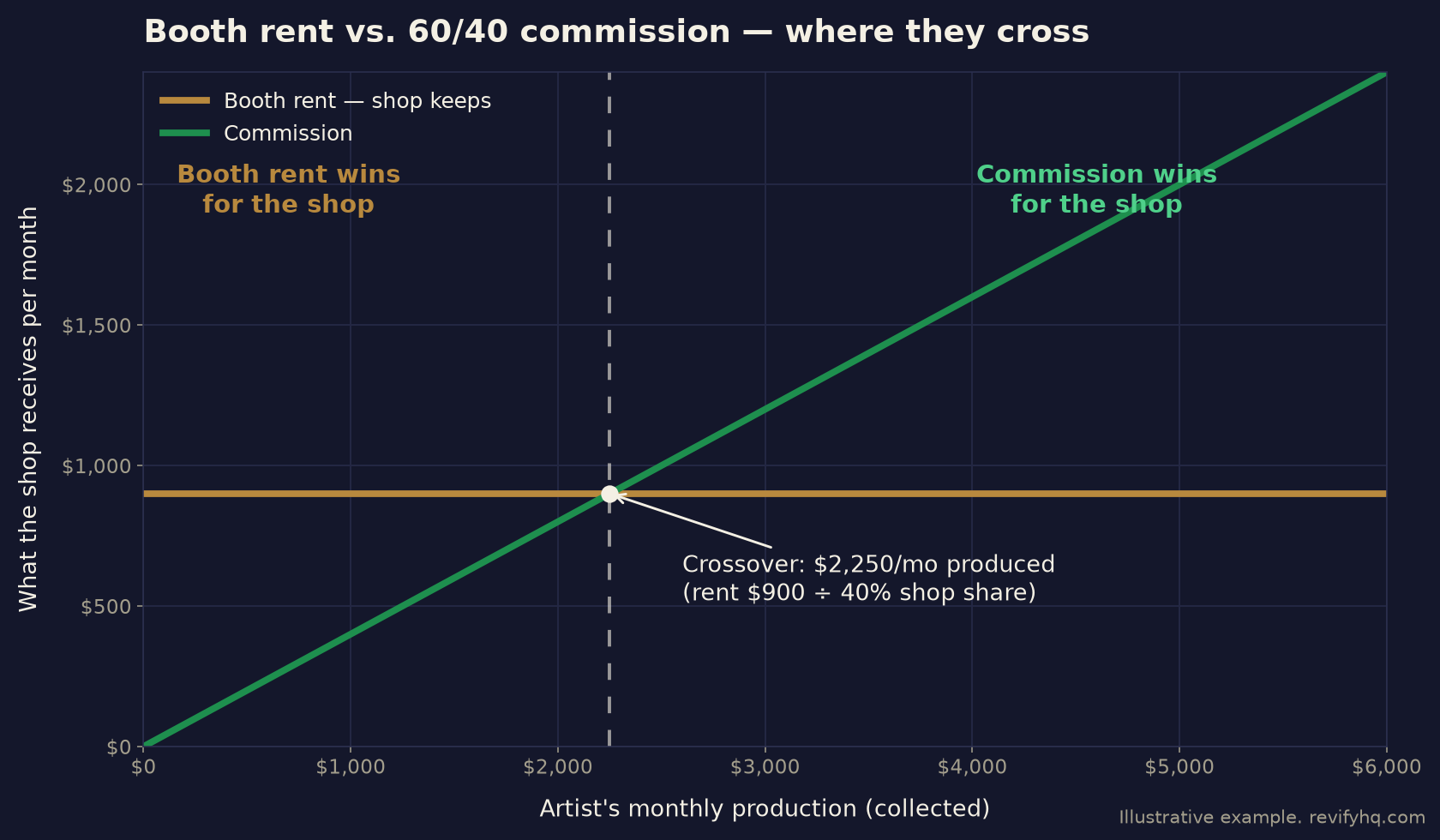
Do this for every chair. Most shops discover they are running the wrong structure for two or three people and the right one for everyone else. The fix is rarely “change the whole shop.” It is usually “change two agreements.”
Step 4: Decide what you are actually selling
Booth rent sells space and predictability. Fixed revenue every month, almost no upside when an artist blows up, artists who market themselves and can give thirty days' notice and go.
Commission sells a business. You fund the marketing, the front desk, the booking system, the supplies, the walk-in traffic — and you get paid on the growth you help create.
The shops that struggle are the ones charging rent-level fees while delivering commission-level services: booking every appointment, buying every box of gloves, running every card, and still collecting a flat $900. Pick one model per artist, price it honestly, and put it in writing.

Step 5: Whichever model you pick, the payments line follows you
This is the part both structures get wrong, and it is usually the largest fixable line item in the shop.
Card processing typically runs somewhere in the neighborhood of 3% of every card sale once you add up the rate, the per-transaction fees, and the monthly extras buried in the statement. On $60,000 a month in card volume, roughly $1,800 leaves the shop.
Under a commission model, the shop covers that. Under booth rent, most shops still run every artist's card sales through the shop's terminal — so the shop still covers it, on revenue it does not even keep a percentage of. That is the worst square on the board: paying roughly 3% on money that passes straight through to somebody else.
Pull last month's statement and find your effective rate: total fees divided by total card volume. If you have never done it, here is how shops end up paying more than they should in the first place.
Then fix the structure. With a compliant dual pricing program, the shop shows a card price and a cash price at the counter, and the customer chooses. And with Revify, the shop earns a Monthly Cash-back of up to 0.75% of card sales, paid back to the business every month on volume that was already running through the terminal. On that same $60,000 in card volume, that is $450 coming back in — with no new clients, no price increase, and no change to how the shop works.
Three numbers to write down this week
- Cost per chair. Total fixed overhead divided by every chair in the shop.
- Your crossover. Booth rent divided by the shop's commission share.
- Your effective processing rate. Last month's total card fees divided by total card volume.
If your booth rent is below the first number, you are losing money on every station. If your best artist is above the second, you already know what conversation you owe them. And if the third number starts with a 3, that is the one you can fix this week without renegotiating anything with anybody.
All figures in this article are illustrative examples, not client data — the point is the method, not our numbers.
Want the payments piece done for you? Run your shop's numbers in our savings calculator, or see what the fees on a single ticket really cost with our tattoo card fee calculator.

